
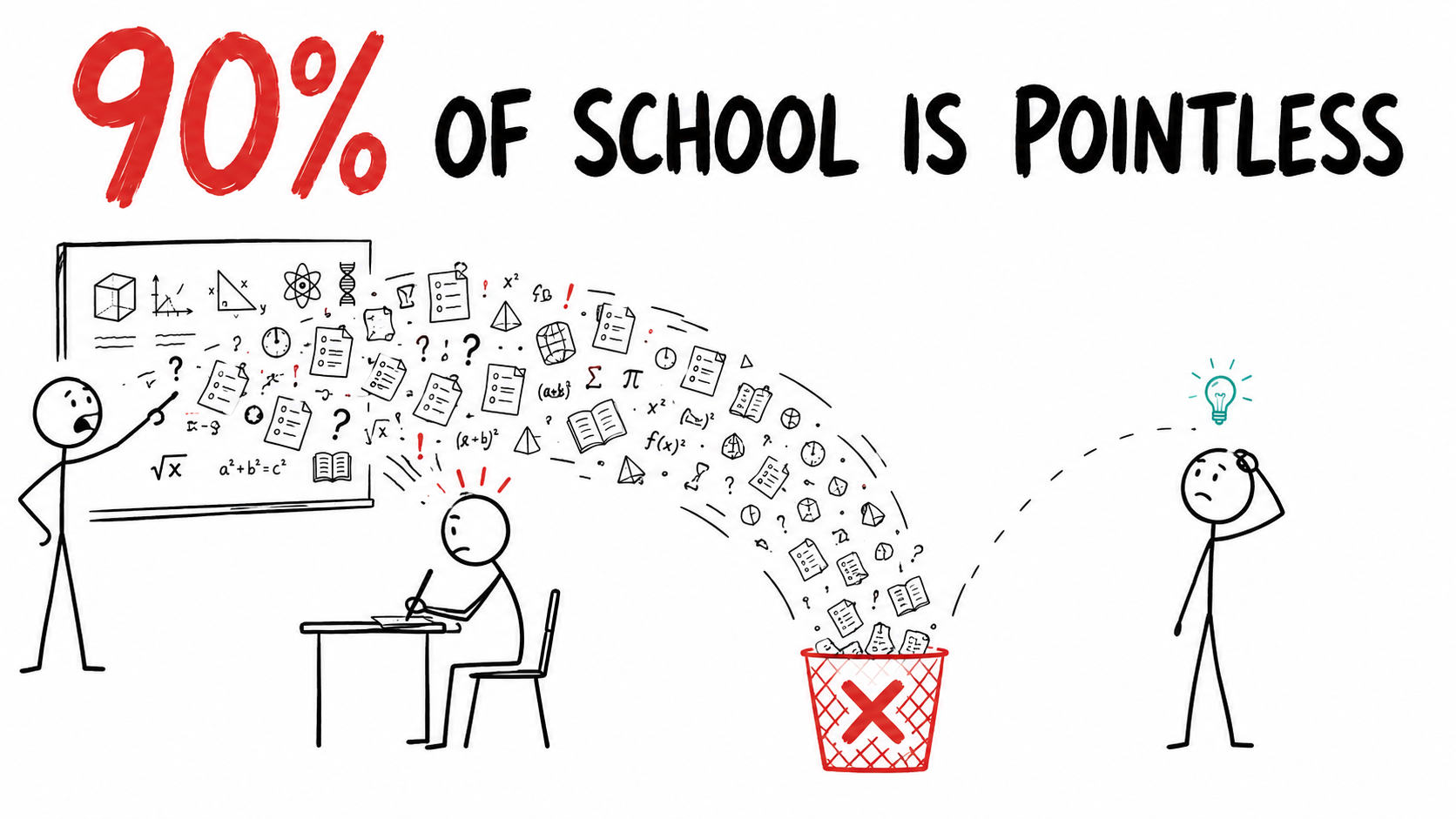
If students forget it after the exam, cannot apply it outside the classroom and never understand why it matters, calling it education does not make it valuable.
Let’s begin with a deliberately offensive claim: ninety percent of school is pointless.
No, that percentage is not a carefully measured scientific result. It is a challenge to an education system that demands thousands of hours of a young person’s life while rarely being required to demonstrate what lasting value those hours created.
Take an average adult and ask them to reconstruct what they learned at school. Do not give them multiple-choice options, familiar textbook pages or clues that allow them to recognize the correct answer. Ask them to explain the concepts, use the knowledge, connect it to a real problem or teach it to someone else.
How much remains?
What happened to the thousands of facts memorized for exams? What happened to the formulas, definitions, historical details, grammatical classifications and scientific concepts that once determined grades, caused stress and consumed entire evenings?
Most of them disappeared.
That does not automatically mean the subjects were worthless. Mathematics, history, science, languages and the arts are not pointless. The uncomfortable truth is more serious: valuable knowledge can be turned into pointless education when it is taught without meaning, learned for temporary performance and forgotten immediately afterward.
School Confuses Exposure With Learning
The education system is extremely good at recording whether something was taught. It is much less interested in discovering whether it became usable knowledge.
A teacher covered the chapter. Students completed the exercises. An exam was held. Grades were entered. The class moved forward. From the institution’s perspective, learning happened.
From the student’s perspective, the information may have remained in memory just long enough to survive the exam before disappearing. The student was exposed to the material, but exposure is not the same as learning. Completing an assignment is not the same as understanding. Passing an exam is not proof that knowledge can still be retrieved, applied or explained six months later.
Yet the school curriculum keeps expanding as if presenting more content automatically creates more education. We measure teaching by what was delivered instead of measuring learning by what changed inside the learner.
That is how an education system can remain incredibly busy while producing remarkably little durable value.
If It Disappears After the Exam, What Was the Point?
The standard response is that students may need this knowledge someday. Perhaps they will, but that defence is weaker than it sounds.
Almost any fact could theoretically become useful in some future situation. That does not justify spending unlimited time teaching everything to everyone. A student’s time, attention and energy are finite. Every hour used on one topic is an hour that cannot be used to master something else.
This means every part of the curriculum should have to answer a basic question: What lasting capability is this supposed to create?
If the answer is that students need to reproduce information on an exam and can then safely forget it, the activity is not meaningful education. It is academic theatre.
If the purpose is to develop reasoning, the student should become better at reasoning. If the purpose is to create scientific understanding, the student should be able to use scientific thinking outside the exact exercise they practised. If the purpose is historical understanding, the student should be better able to recognise patterns, evaluate claims and understand the forces shaping the present.
When none of that happens, saying that the topic was “part of a broad education” is not an explanation. It is a way of avoiding accountability.
Students Are Not Too Stupid to Recognise Pointlessness
Adults often complain that students lack motivation, but students are constantly making judgments about value. They ask themselves whether an activity matters, whether effort will produce a meaningful result and whether the knowledge connects to anything they care about.
These judgments are not always accurate. Young people do not automatically recognise the future value of algebra, writing, history or disciplined practice. Education must sometimes introduce students to things whose importance they cannot yet see.
However, that does not give schools permission to ignore perceived value completely.
If students repeatedly receive tasks without understanding their purpose, school begins to feel like an endless system of arbitrary demands. They learn that success means doing what they are told, producing the expected answer and forgetting the material when permission is finally granted to move on.
Then we blame them for not being curious.
The problem is not necessarily that the knowledge lacks value. The problem is that the educational experience has failed to reveal it. A valuable concept taught without context, purpose, application or sufficient mastery can feel indistinguishable from useless information.
Motivation cannot be reduced to entertainment, but neither can it be separated from meaning.
The Real Waste Is Not Forgotten Information
Forgetting facts is not the greatest failure. Human beings forget things, and no education system can make every lesson permanent.
The greater failure is spending years in school without becoming significantly better at learning.
Students should leave school knowing how to approach something they do not understand, identify gaps in their knowledge, break complex subjects into manageable parts, practise effectively, retrieve information from memory, evaluate whether they have actually mastered something and change their strategy when progress stops.
Instead, many students leave believing that learning ability is something they either possess or lack. The successful students conclude that they are intelligent. The struggling students conclude that they are not. Neither group may have learned much about how learning actually works.
That is an astonishing result for an institution whose central purpose is supposedly education.
We teach students what to learn while assuming they already know how to learn it. We assess the outcome without teaching the process. When students struggle, we often respond with more assignments, more repetition or lower expectations instead of helping them understand why their current approach is failing.
If school taught students how to learn independently, even forgotten content could retain value because the learner would know how to rebuild it. Without that capability, students remain dependent on teachers, instructions and prepared material long after their education ends.
School Should Not Attempt to Predict Every Fact You Will Need
The modern world has made one traditional assumption increasingly absurd: that schools can prepare students for adulthood by deciding in advance which information everyone will need.
The amount of available knowledge is effectively infinite. A school curriculum is not.
Careers change. Technology changes. Industries disappear. New fields emerge. Artificial intelligence can explain concepts, generate examples and retrieve information almost instantly. Under these conditions, the purpose of school cannot simply be to transfer the largest possible collection of facts from one generation to the next.
Foundational knowledge still matters enormously. You cannot think critically about something you know nothing about, and searching for information is difficult when you lack the background knowledge needed to judge what you find. AI does not remove the need to know; it increases the importance of knowing enough to recognise when an answer is misleading, incomplete or wrong.
But education must distinguish between knowledge that creates a foundation and content that merely occupies time.
The goal should not be to teach students everything they might someday need. It should be to give them strong foundations and the ability to learn whatever their future demands.
Make Every Part of School Earn Its Place
Claiming that 90% of school is pointless does not mean deleting 90% of the curriculum tomorrow. It means refusing to assume that something creates value merely because schools have taught it for decades.
Every major learning objective should be able to answer:
- Why does this matter?
- What should students still understand a year from now?
- Where can this knowledge be applied?
- How will students practise retrieving and using it?
- How does it connect to knowledge they already have?
- How will we know whether they can transfer it to a new situation?
- What valuable capability remains even if some details are forgotten?
If these questions cannot be answered, the topic may not deserve the amount of time it currently receives. If they can be answered but students still fail to see or experience that value, the teaching process needs to change.
Education reform does not require replacing every subject with lessons about taxes, job interviews and household maintenance. “Real-world skills” are important, but education should do more than train people to complete everyday transactions. It should expand what students can understand, imagine, question and create.
However, intellectual development is not produced by forcing students through enormous quantities of disconnected content. Depth matters. Transfer matters. Retention matters. Curiosity matters. The ability to keep learning after school matters.
Coverage is not the same as education.
What Would a Less Pointless School Look Like?
A less pointless school would teach fewer things superficially and more things deeply. It would clearly distinguish between information students need to recognise, knowledge they need to remember and skills they need to apply independently.
Students would encounter important ideas repeatedly rather than abandoning each topic after the exam. Assessment would test whether knowledge can be used in unfamiliar situations, not merely reproduced in the same format in which it was taught. Students would receive support based on what they actually understand instead of being moved forward because the calendar requires it.
Most importantly, learning itself would become part of the curriculum.
Students would learn why retrieval is more powerful than rereading, why confusion is a normal part of building understanding, why mistakes provide information and why difficulty does not automatically mean inability. They would learn to monitor their own understanding and take increasing responsibility for what happens next.
This is also the idea behind APUOPE. The purpose should not be to help students process more meaningless schoolwork at greater speed. It should be to turn confusing material into deliberate practice, reveal what the learner actually knows and help build knowledge that survives beyond the next exam.
Technology should not make educational waste more efficient. It should help us identify and remove it.
Maybe It Is Not Exactly 90%
Perhaps 90% is exaggerated. Perhaps the real number is 70%, 50% or only 30%. Would that make the situation acceptable?
If even one-third of the thousands of hours spent in school produces no durable knowledge, transferable capability, meaningful experience or deeper understanding, the waste is still enormous. The precise percentage is less important than the question the provocation forces us to ask: After all those lessons, assignments, exams and years, what can the student now understand, do or become that they could not before?
Schools should not be judged by how much content they deliver. Teachers should not be judged by how quickly they move through a curriculum. Students should not be judged primarily by how effectively they temporarily perform knowledge for an examiner.
Education should be judged by the value that remains.
A child’s time is not free. Attention is not an unlimited natural resource, and childhood cannot be repeated when we later discover that much of it was spent satisfying outdated institutional routines.
Any system demanding that much of a person’s life carries the burden of proving that the time mattered.
Right now, school receives those years automatically.
Perhaps it is time we stopped assuming it has earned them.