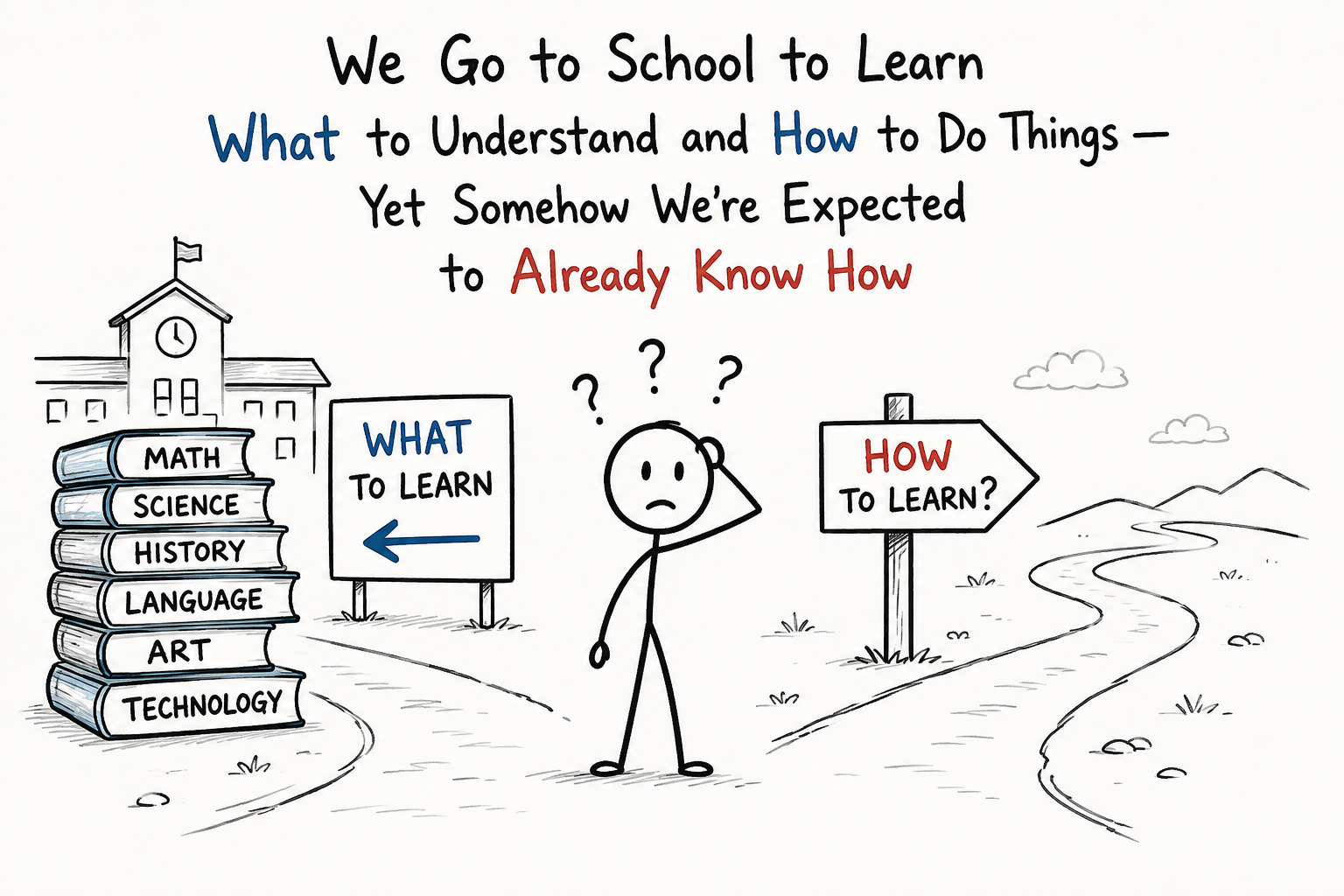
We teach students what to understand, what to remember and what to do. But the process that makes all of that possible — learning itself — is often left for them to figure out on their own.
We go to school to learn. That is supposedly the whole point. We spend years learning mathematics, languages, science, history and eventually increasingly specialized subjects. We are taught how to solve equations, write essays, interpret texts, conduct experiments, remember facts and apply theories. Yet underneath all of this sits a surprisingly large assumption: before any of that can work, the student is expected to already know how learning itself works.
That assumption becomes visible the moment learning stops being easy.
What should a student actually do when they read something three times and still do not understand it? How are they supposed to know whether they genuinely know something or merely recognize it because they have seen it several times? How should they make something stay in memory for more than a few days? How should they divide a difficult subject into manageable parts, decide what to practice next, recognize when their current method is failing, and know when something has actually been mastered?
These are not peripheral study skills. They are the machinery underneath almost everything education asks students to do.
And yet we often teach the subject before we teach the machinery.
We Teach the Destination, Then Leave Students to Find the Route
Education is usually quite good at defining what students should know. There are curricula, learning objectives, textbooks, assignments, exams and grading criteria. A student can often be told with remarkable precision what they are expected to know by Friday.
What is much less clear is how they are supposed to get there.
Imagine telling someone that they need to reach the top of a mountain, showing them a photograph of the summit and then evaluating them based on whether they arrive. Some people might find the route quickly. They may have climbed similar mountains before, know how to read the terrain or have someone experienced walking beside them. Others may head in the wrong direction, exhaust themselves, become discouraged and eventually conclude that they simply are not good at climbing.
Learning can work in much the same way.
Some students gradually develop effective ways of studying through good teachers, supportive parents, hobbies, books, experimentation or sheer luck. They learn how to ask useful questions, break complex problems into smaller ones, retrieve knowledge from memory and adjust their approach when something does not work.
Others do not.
Yet we often interpret the difference in outcomes as a difference in intelligence, motivation or effort.
Sometimes it is.
But sometimes one student simply has a better map.
Not Understanding Something Is Not the Problem. Not Knowing What to Do Next Is.
One of the most valuable learning abilities is knowing how to react to confusion.
Every learner eventually reaches a point where something does not make sense. Perhaps a mathematical concept feels incomprehensible, a paragraph in a textbook seems impossible to follow, or a teacher's explanation assumes knowledge the student never properly learned.
The important moment is not the confusion itself. Confusion is normal.
The important question is what happens next.
A student without a reliable learning process may simply repeat the same action. Read the paragraph again. Look at the example again. Try the same exercise again. When that fails, the frustration slowly becomes personal. Instead of thinking, I haven't found the missing piece yet, the student starts thinking, I'm bad at this.
A stronger learner approaches the same problem differently. They try to locate the exact point where understanding broke down. They ask whether an earlier concept is missing, whether the explanation can be simplified, whether an example would help, whether the problem can be visualized or whether the idea can be explained in their own words.
The difference is not necessarily talent.
It is having a process for dealing with not knowing.
This is one of the ideas behind APUOPE. A learning system should not merely throw more content at a student when they struggle. It should help uncover why the struggle exists. If the obstacle is a missing prerequisite, the learner needs to go backwards. If the concept is understood but cannot be remembered, the learner needs retrieval practice. If the learner can recall the information but cannot apply it, the practice needs to change again.
The question should not simply be, “Did you get this wrong?”
The more useful question is, “What does getting this wrong tell us about what you need next?”
Familiarity Is One of Learning's Most Convincing Illusions
One reason studying can fail is that ineffective learning often feels surprisingly effective.
You read a chapter once and it seems difficult. You read it again and the terminology becomes familiar. By the third time, the sentences feel almost obvious. You recognize the diagrams and remember roughly where information appears on the page.
That feeling is reassuring.
Unfortunately, it can also be misleading.
Recognition is not the same thing as retrieval.
A student can look at an answer and immediately think, Of course, I knew that, while being completely unable to produce the same answer without seeing it first. This is why hours of studying can sometimes produce surprisingly little durable knowledge. The learner has spent a great deal of time seeing the information, but very little time attempting to reconstruct it.
A learning system should therefore do more than show information repeatedly.
It should make knowledge disappear.
Then ask for it back.
That is why APUOPE places so much emphasis on turning material into active practice rather than treating uploading, summarizing or rereading content as the end of the learning process. A summary may make material easier to consume, but easier consumption is not automatically better learning.
At some point, the learner has to produce the knowledge themselves. They have to answer, recall, explain, rebuild, apply and occasionally get it wrong.
That is where the interesting part begins.
Remembering Should Not Be Left to Luck
Students are routinely told to remember things without being taught much about remembering.
Learn these words. Know these formulas. Remember these historical events. Understand this chapter for the exam.
The instructions describe the desired result, but often say little about the process.
Many students naturally respond by increasing exposure. They read the notes again, highlight the important sections, rewrite something neatly and then look through it once more. These activities are not useless, but they can easily become substitutes for the much harder task of retrieving knowledge without assistance.
Long-term learning requires the brain to repeatedly reconstruct information. That is why retrieval, spacing and revisiting knowledge over time are so powerful. The important question is not how many times something has entered your eyes. It is whether you can bring it back when it is no longer visible.
This changes how a learning platform should work.
APUOPE should not aspire to become the world's most convenient place to stare at beautifully organized information. There are already plenty of ways to do that.
Its job is to turn information into something the learner has to work with.
An important fact might first appear as an explanation, later as a question, then as a reconstruction task, then reappear after some time has passed. If the learner struggles, that information should influence what happens next.
The purpose is not to make studying frictionless.
The purpose is to put friction in the right places.
Learning Is Not Content Consumption
This distinction becomes easier to understand when we compare academic learning with almost any practical skill.
Nobody seriously believes that you learn to drive by reading the driver's handbook repeatedly. You need to sit behind the wheel. Nobody expects someone to become a pianist by watching someone else play scales. Nobody becomes good at football by studying diagrams of passing patterns without ever touching a ball.
Practice requires production.
Academic learning is not fundamentally different.
If you want to learn mathematics, eventually you have to solve problems without following an example step by step. If you want to learn a language, you have to retrieve words and construct sentences. If you want to understand biology, you have to explain processes, recognize relationships and apply concepts outside the exact wording of the textbook.
The learner has to do something that reveals whether learning has actually happened.
This is also why APUOPE cannot merely be an AI that gives increasingly good explanations.
AI is becoming extraordinarily good at explaining things. It can rewrite difficult text, simplify concepts, generate examples and answer questions endlessly.
That is useful.
But there is a danger.
If AI removes every difficult step, it can also remove some of the work that creates learning.
A good learning system should know when to help and when to stop helping. Sometimes the best next step is another explanation. Sometimes the best next step is to remove the explanation and ask the student to try.
The goal is not to make the learner dependent on an increasingly capable tutor.
The goal is to make the tutor progressively less necessary.
Failure Is Not a Verdict. It Is Diagnostic Data.
School often gives mistakes an unfortunate emotional meaning.
A wrong answer loses a point. A poor test result becomes a grade. Enough bad grades can easily become part of a student's identity.
“I'm bad at maths.”
“I can't learn languages.”
“I'm just not academic.”
The problem is not that schools evaluate performance. Evaluation is necessary.
The problem appears when a mistake tells us only that something went wrong rather than helping us understand why.
From a learning perspective, a wrong answer is valuable information.
Perhaps the learner misunderstood the current concept. Perhaps the real problem is an earlier concept that was never mastered. Perhaps the student knew the information last week but could not retrieve it today. Perhaps the knowledge is there, but the learner cannot yet apply it in a new context.
Those are completely different problems.
They should not produce the same response.
This is one of the areas where adaptive learning can become genuinely useful. Instead of simply producing another score, APUOPE can use mistakes to build a better picture of the learner. The platform should gradually discover where knowledge is strong, where it is fragile and where something underneath the current topic is missing.
A wrong answer can therefore become the beginning of a route rather than the end of an assessment.
Weakness discovered. Mastery opportunity unlocked.
The Real Skill Is Learning to Navigate Your Own Learning
There is another reason this matters.
The amount of knowledge available to us is becoming effectively infinite.
A student today can access textbooks, videos, university lectures, AI tutors, exercises, simulations and explanations covering almost any subject imaginable. Information that once required access to a university library can now appear on a phone in seconds.
That sounds like an enormous educational advantage.
It is.
But it also changes the bottleneck.
The problem increasingly is not finding information.
The problem is deciding what matters, understanding it, connecting it to what you already know, noticing what you do not understand, practicing effectively and turning all of that information into something you can actually use.
Your learning possibilities may be almost infinite.
Your time and attention are not.
This makes learning how to learn more important than it has ever been.
A person who knows how to learn can approach a new subject, identify the landscape, find the gaps in their knowledge, build the necessary foundations, practice deliberately and continuously adjust their strategy.
A person who does not know how to learn can have access to the entire internet and still remain stuck.
Some Students Have Been Quietly Taught This All Along
One uncomfortable aspect of education is that students do not enter the classroom with equal learning tools.
Some have parents who ask them to explain their thinking. Some are encouraged to read, experiment, build things and ask questions. Some play instruments, compete in sports or have hobbies that have already taught them how deliberate practice works. Some have experienced adults who show them how to break a difficult problem into smaller parts.
Others arrive without those advantages.
Then both groups are given the same assignment.
We call that equal treatment.
But equal assignments do not necessarily mean equal starting conditions.
If one student already understands how to retrieve information, manage frustration, identify gaps and change strategy while another student thinks studying means reading the same chapter until it feels familiar, their results may diverge dramatically even if both are equally capable of learning.
The second student does not necessarily need a lower expectation.
They may need better tools.
This is a major part of what APUOPE should exist to address.
The platform should not be designed only for the student who already knows how to study and simply wants to study faster.
It should also work for the student sitting in front of a difficult subject thinking:
I don't even know where to start.
APUOPE Should Teach the Process, Not Just Deliver the Answer
There are already thousands of educational products that can summarize material, generate quizzes, explain concepts and create flashcards.
Those features are useful, but they are becoming commodities.
AI can generate them almost instantly.
The more interesting opportunity is to build a system around the learning process itself.
APUOPE should help the learner answer questions such as: What am I actually trying to learn? What do I already understand? Where is the first real gap? What prerequisite is missing? What should I practice next? Can I retrieve this without help? Do I understand it well enough to explain it? Is this knowledge becoming stronger over time? What should I revisit tomorrow?
And perhaps most importantly:
What should I do when what I'm currently doing isn't working?
That is a very different ambition from simply making educational content more convenient.
It is an attempt to help students build the internal machinery of learning.
Maybe Education Has the Order Backwards
We naturally ask what students should know.
That question matters.
But perhaps we should ask another question first:
Do students know how to go from not knowing to knowing?
Because that journey is the foundation underneath every curriculum.
A student who knows how to learn does not need to know everything already. They can encounter something unfamiliar and begin working through it. They can identify confusion without treating it as failure, test whether their understanding is real, retrieve knowledge rather than merely recognize it, break large goals into smaller problems and change strategy when progress stops.
Eventually, they become less dependent on the teacher, the textbook and even the AI.
That should be the destination.
Not a student who has perfectly memorized everything we decided was important this year.
A person who can look at something completely unfamiliar and think:
I don't know this yet. But I know what to do next.
That may be one of the most valuable things education could ever teach.
And it is exactly the problem APUOPE should be trying to solve.
Learning how to learn may be the one subject that makes every other subject easier.