
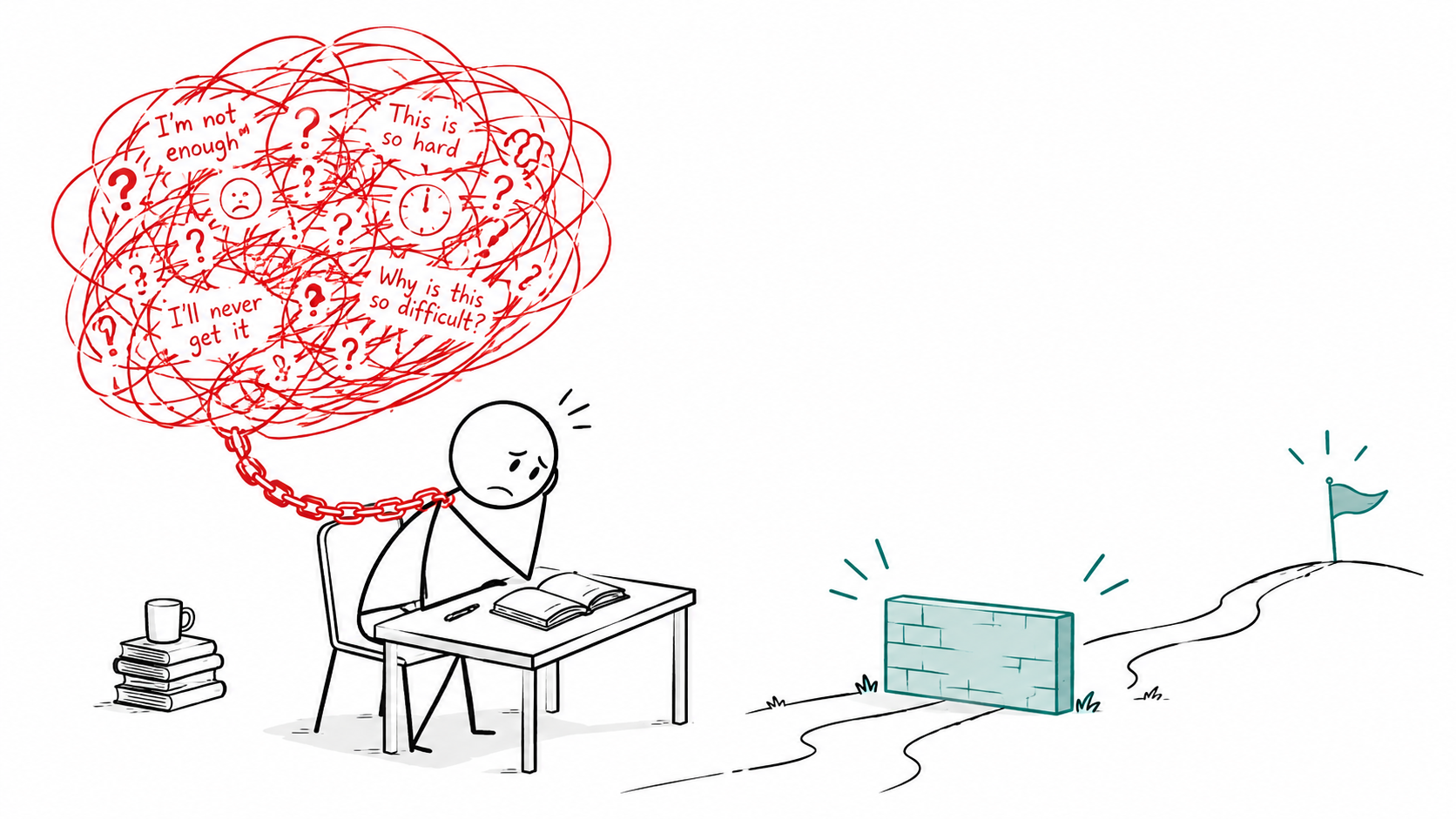
Difficulty is real. But the story we attach to it can create a second layer of struggle.
Learning is supposed to be difficult sometimes, yet we often react to difficulty as if it were evidence that something has gone wrong. A student opens a mathematics problem and does not immediately know what to do. A chapter in biology feels confusing. A new language refuses to stick. An exam topic seems harder than expected. The original problem is simple enough: the task is difficult.
Very quickly, however, another problem can appear on top of it. The student begins to wonder why the task feels so difficult, whether they should already understand it, why others seem to be progressing faster, and whether the struggle means they are simply not good at the subject.
At that point, the student is no longer dealing only with the learning task. They are also dealing with frustration, uncertainty, self-doubt and the growing belief that difficulty says something about their ability.
The task itself has not become harder, but the total psychological load has increased. This is one of the easiest ways to make hard things harder.
Difficulty Creates One Load. Our Interpretation Can Create Another.
A difficult learning task creates genuine cognitive load. You may need to hold several ideas in working memory, connect new information to previous knowledge, retrieve facts, test different approaches and identify exactly where your understanding breaks down. That effort is not a flaw in learning. In many cases, it is learning.
The problem begins when the brain starts working on something else at the same time. Instead of focusing entirely on the equation, concept or argument in front of you, part of your attention becomes occupied with thoughts about your own performance. You begin comparing yourself with others, worrying about how long the task is taking or interpreting confusion as evidence that you are not capable enough.
Those thoughts do not help solve the problem, but they still consume attention. This creates two different forms of struggle. The first comes from the task itself. The second comes from the meaning we attach to struggling with the task.
That second layer matters because the mental resources available for learning are limited. Working memory, attention and energy are all limited. When some of those resources are spent managing frustration, fear or self-judgment, fewer remain available for actually understanding the material.
“This Is Hard” and “I Can't Do This” Are Completely Different Claims
There is an important difference between noticing that something is difficult and concluding that you are unable to do it. “This is hard” describes your current interaction with the task. “I can't do this” makes a prediction about your ability.
That shift happens surprisingly easily in education. A student struggles with fractions for twenty minutes and begins to believe they are bad at mathematics. Someone preparing for an entrance exam forgets something they learned yesterday and interprets the failure as proof that they have a poor memory. A student reading a difficult academic text decides that they are simply not intelligent enough to understand the subject.
None of those conclusions logically follows from the original observation. Difficulty tells you that the current demands exceed what you can currently handle effortlessly. It does not tell you whether you will understand the topic tomorrow, after another explanation, after learning a missing prerequisite or after ten more attempts.
In fact, the gap between what you can currently do easily and what you cannot yet do is precisely where a large part of learning happens.
Experience Changes Our Capacity to Handle Difficulty
Think about something you can now do comfortably that once required intense concentration. Driving a car is a good example. At the beginning, steering, mirrors, gears, traffic signs, speed and the movements of other vehicles all compete for attention. Eventually, many of those actions become almost automatic.
The road did not necessarily become easier. Your ability to deal with its demands changed.
The same happens in learning. Experience gives us patterns to recognize, previous examples to compare against and a better sense of what to do when we become stuck. Perhaps most importantly, experience reduces uncertainty.
When you encounter a difficult situation for the first time, you do not know what the experience means or how long it will last. After encountering similar situations repeatedly, the struggle itself becomes more familiar. You begin to recognize that confusion is temporary, that wrong answers are recoverable and that a difficult part of the process does not automatically predict failure.
That changes the amount of psychological load created by the same objective difficulty. An experienced learner may encounter confusion and think that they have reached a part that requires more work. An inexperienced learner may experience exactly the same confusion and interpret it as evidence that they are not capable of learning the subject.
The task is the same. The experience of the task is not.
Your Ability to Handle Learning Depends on the Resources Available
People do not enter learning situations with a fixed amount of capacity. The resources available at a particular moment can change dramatically.
Sleep, nutrition, stress, physical condition, time pressure, previous knowledge, confidence and social support all influence how much learning load a person can handle. Even something as simple as knowing where to begin can make a major difference.
This is why telling a struggling student to simply try harder is often a poor response. The problem may not be a lack of effort at all. The student may lack the resources needed to handle the demands placed on them.
If prerequisite knowledge is missing, additional effort may simply produce additional frustration. If the student is exhausted, maintaining attention becomes more difficult. If they are staring at hundreds of pages without understanding which concepts matter, the cognitive burden begins before meaningful studying has even started.
Good learning support therefore should not focus only on reducing the difficulty of the material. It should also increase the learner's capacity to handle difficulty by improving the resources available to them.
Not Every Form of Struggle Should Be Removed
Education technology, and especially AI, is becoming exceptionally good at reducing friction. A student can ask for an explanation, receive a summary, generate examples, simplify difficult text, get a hint or see a complete solution almost instantly.
This can be enormously useful, but it creates an important distinction that learning technology needs to understand: some difficulty is unnecessary, while some difficulty is essential.
Trying to retrieve something from memory is more difficult than simply rereading it, but retrieval is often exactly what strengthens memory. Solving a problem independently is more demanding than watching someone else solve it. Explaining an idea in your own words requires more effort than recognizing the correct answer from a list of alternatives.
Removing all of this difficulty would make studying feel smoother while potentially making learning weaker. The objective should therefore not be to make learning effortless. It should be to remove unnecessary friction while preserving productive struggle.
That distinction is especially important as AI becomes increasingly capable of doing difficult cognitive work on behalf of the learner. The easiest possible learning experience is not necessarily the most effective one.
Sometimes Accepting Difficulty Reduces Its Psychological Cost
One useful response to difficulty is remarkably simple: stop treating the feeling of difficulty as evidence that something is wrong.
This does not require pretending that the task is easy or convincing yourself that you enjoy struggling. It means accepting that certain forms of learning are supposed to demand effort.
A difficult chapter may take several readings. A mathematical concept may require several explanations. You may fail repeatedly before understanding what you are doing wrong. You may discover that an earlier gap in your knowledge needs to be repaired before you can continue.
None of those experiences proves that you are incapable of learning. Once difficulty is accepted as a normal part of the process, some of the psychological battle surrounding it can disappear. The original cognitive challenge remains, but the learner no longer has to spend additional energy resisting the fact that the challenge exists.
This is an important part of building what could be called a greater capacity for struggle. Experience helps because the learner has survived similar situations before. Resources help because the learner has more ways to respond. Interpretation helps because difficulty is no longer automatically translated into failure.
Learning Changes When Struggle Stops Becoming a Verdict
One of the most damaging ideas a learner can develop is the belief that capable people should not struggle. If that assumption is accepted, every difficult experience becomes threatening. Confusion suggests low intelligence. Forgetting suggests a bad memory. Slow progress suggests lack of talent. A wrong answer becomes evidence of inability rather than information about what needs more work.
A healthier interpretation does not remove the difficulty. It changes what the difficulty means.
Confusion can reveal a missing connection. Forgetting can show what needs another retrieval attempt. A wrong answer can expose an incomplete mental model. Slow progress can simply indicate that a topic needs more repetitions than expected.
These interpretations are not empty positive thinking. They are practical descriptions of how learning actually works. The learner still needs to do the work, but the work no longer has to become a judgment about the person doing it.
APUOPE Should Remove Useless Struggle, Not Useful Struggle
This distinction is important for APUOPE. The purpose of a learning platform should not be to create a world where students never feel confused, never make mistakes and never have to work hard. A system like that might feel pleasant, but it would misunderstand what learning requires.
The better goal is to separate productive difficulty from unnecessary difficulty.
Productive difficulty includes trying to retrieve an answer before seeing it, reconstructing a concept from memory, returning to something that was previously answered incorrectly and explaining why an answer is correct. These activities can feel demanding precisely because the learner is doing cognitive work.
Unnecessary difficulty is different. It includes not knowing where to begin, not knowing what matters, being overwhelmed by large amounts of material without structure, repeatedly practicing things that are already mastered while important weaknesses remain hidden, or having no idea whether progress is being made.
That kind of friction does not make learning stronger. It merely consumes resources that could have been spent learning.
APUOPE should therefore make the learning process clearer without making the learning itself empty. It should help identify what matters, expose weaknesses, organize the next steps and make progress visible, while still requiring the learner to retrieve, think, reconstruct and struggle in the places where struggle creates value.
The Goal Is Not Easier Learning. It Is Greater Capacity for Learning.
There is an important difference between making a task easier and making a learner more capable. If every difficult experience is immediately removed, the learner may never develop the experience, resources and interpretation needed to handle more demanding situations independently.
A stronger approach is to help learners gradually increase their capacity to receive learning-related load. That means building knowledge and experience, creating routines, improving access to support, reducing unnecessary uncertainty and helping students understand that difficulty is not automatically a warning sign.
Sometimes difficulty simply means that the learner has reached the boundary between what they can already do and what they are still learning to do. The challenge itself may be unavoidable. The second layer of struggle often is not.
Learning is already difficult enough.
Stop making hard things harder.